

AP Chemistry
điện phânelectrolysis
electrolysisVietnamese: điện phân
Còn gọi:Also called: sự điện phân
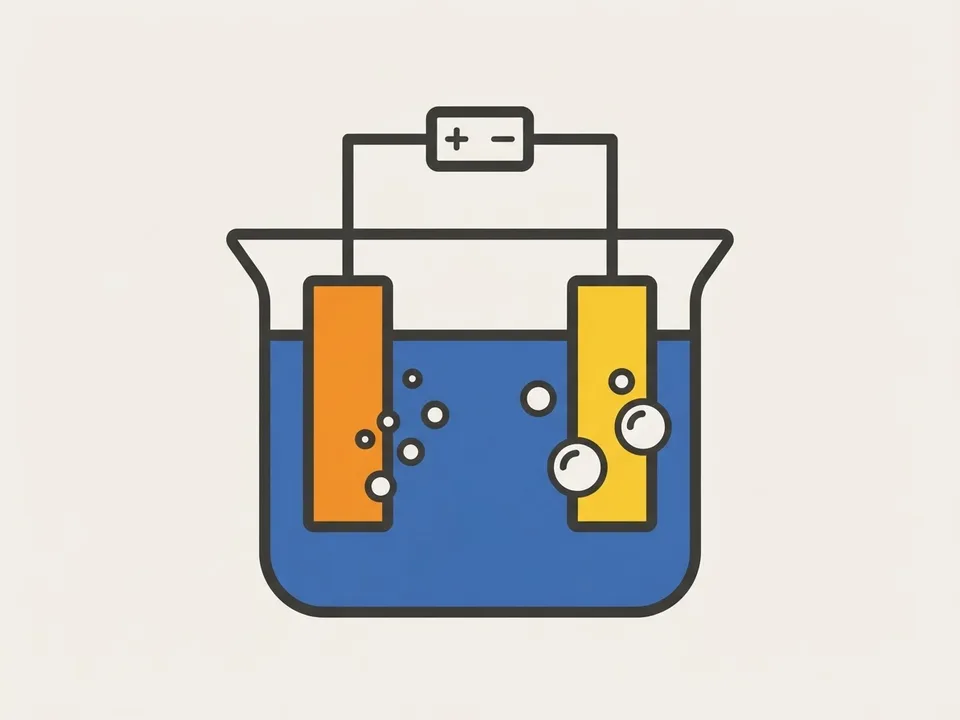
Điện phân là quá trình dùng dòng điện một chiều để thúc đẩy phản ứng oxi hóa–khử không tự phát xảy ra tại hai điện cực.Electrolysis is the use of a direct current to drive a nonspontaneous oxidation–reduction reaction at two electrodes.
Trực giác: Hãy tưởng tượng dòng điện một chiều như một cỗ máy bơm cưỡng bức, ép nước chảy ngược từ nơi thấp lên nơi cao mà bình thường nước không tự chảy được — bơm electron vào cực âm để khử ion dương thành chất mới, và rút electron ở cực dương để oxi hóa ion âm thành chất mới.Intuition: Think of the direct current as a forced pump that pushes water uphill, something it would never do on its own: electrons are pumped into the negative electrode to reduce cations into new substances, and pulled out of the positive electrode to oxidize anions into new substances.
Công thức chínhKey formula
Định nghĩa đầy đủFull definition1 phút đọc1 min read
Điện phân là quá trình dùng dòng điện một chiều từ nguồn ngoài để thúc đẩy phản ứng oxi hóa–khử không tự phát tại hai điện cực. Chất điện li có thể nóng chảy hoặc ở dạng dung dịch; khử xảy ra ở catot, còn oxi hóa xảy ra ở anot.
Khác pin Galvani tạo điện từ phản ứng tự phát, bình điện phân tiêu thụ điện năng. Theo định luật Faraday, lượng chất tạo thành liên hệ với điện tích truyền qua, khối lượng mol và số electron trao đổi.
Electrolysis is the use of a direct current from an external source to drive a nonspontaneous oxidation–reduction reaction at two electrodes. The electrolyte may be molten or in solution; reduction takes place at the cathode and oxidation at the anode.
Whereas a galvanic cell generates electricity from a spontaneous reaction, an electrolytic cell consumes electrical energy. Faraday's law relates the amount of substance produced to the charge passed, the molar mass, and the number of electrons exchanged.
- •
- • C/mol
- •, ,
- •
- • C/mol
- •, ,
Công thức chi tiếtFormula details3 công thức3 formulas
Dùng khi dòng điện không đổi để tính điện lượng qua bình từ cường độ dòng điện và thời gian điện phân.Use this for a constant current to find the charge passed through the cell from the current and the electrolysis time.
Trong đóWhere
Dùng để đổi giữa số mol electron trao đổi và điện lượng cần cung cấp.Use this to convert between the moles of electrons exchanged and the charge that must be supplied.
Trong đóWhere
Dùng để tính khối lượng chất tạo ở điện cực khi biết dòng điện, thời gian, khối lượng mol và số electron trao đổi.Use this to find the mass of substance formed at an electrode from the current, time, molar mass, and number of electrons exchanged.
Trong đóWhere
Hay hiểu saiCommon misconceptions3 ý · 1 phút đọc3 points · 1 min read
Catot không luôn là cực dương.
Khử luôn xảy ra ở catot, oxi hóa luôn ở anot. Trong điện phân, catot nối với cực âm của nguồn vì nguồn ngoài đẩy electron vào đó.
không có nghĩa phản ứng hoàn toàn không thể xảy ra.
Trong bài phân biệt bình điện phân, dấu âm cùng cho biết quá trình không tự phát và cần nguồn điện ngoài.
Không được coi số mol electron bằng số mol sản phẩm.
Phải dùng hệ số electron của nửa phản ứng để đổi mol chất thành mol electron trước khi tính điện lượng hoặc dòng điện.
The cathode is not always the positive electrode.
Reduction always occurs at the cathode and oxidation at the anode. In electrolysis the cathode connects to the negative terminal, because the external source pushes electrons into it.
A negative does not mean the reaction is impossible.
When you identify an electrolytic cell, the negative sign together with shows the process is nonspontaneous and needs an external power source.
Moles of electrons do not equal moles of product.
Use the electron coefficient from the half-reaction to convert moles of substance into moles of electrons before calculating charge or current.
Mẹo phòng thiExam tips2 mẹo2 tips
Viết hai nửa phản ứng trước khi tính.
Từ hệ số electron, đổi theo chuỗi gam → mol chất → mol electron → coulomb → ampe.
Kiểm tra đơn vị trước khi chọn biểu thức.
Khi tính cường độ dòng điện, kết quả phải rút gọn về C·s⁻¹, tức ampe; cách này phát hiện sai vị trí , thời gian hoặc hệ số electron.
Write both half-reactions before calculating.
The electron coefficient lets you follow the chain grams → moles of substance → moles of electrons → coulombs → amperes.
Check units before choosing an expression.
A current must reduce to C·s⁻¹, that is amperes; this check catches a misplaced , time, or electron coefficient.
Khái niệm này sinh ra từ đâuWhere the concept comes from1 phút đọc1 min read
1834Michael FaradayWilliam WhewellWilliam NicholsonAnthony Carlisle
Vì sao mang đúng cái tên này? Cái tên nghe lạ tai này thật ra là một từ ghép Hy Lạp do mục sư William Whewell, một nhà bác học người Anh, đặt giúp Faraday. Phần đầu "electro-" bắt nguồn từ ἤλεκτρον, nghĩa gốc là "hổ phách" — thứ nhựa cây hóa thạch mà từ thế kỷ 17 người ta đã gắn với các hiện tượng điện, vì cọ xát nó lên vải thì nó hút được vụn giấy. Phần sau, λύσις, nghĩa là "sự nới lỏng", "sự hòa tan". Ghép lại, từ này mô tả đúng bản chất quá trình: dùng điện để nới lỏng rồi bẻ gãy các liên kết đang giữ hợp chất lại với nhau. Cũng trong công trình năm 1834, Faraday đặt luôn những tên gọi đi kèm mà đến nay vẫn chưa đổi: điện cực (electrode), chất điện li (electrolyte), cực dương (anode), cực âm (cathode), cùng cặp anion và cation để chỉ hai loại ion di chuyển ngược chiều nhau trong dung dịch. Vì vậy, khi đọc một đề thi tiếng Anh về chủ đề này, phần lớn thuật ngữ bạn gặp đều là chữ của một người, viết ra trong cùng một năm.
Bạn nắm chắc chưa?Check your understanding
Quiz câu thật từ ngân hàng đềReal exam questions from our question bank
Vài câu thật gắn đúng khái niệm này, chấm ngay kèm giải thích từng đáp án — hệ thống ghi nhớ bạn nắm tới đâu.A few real questions on exactly this concept, graded instantly with an explanation for every choice — the system remembers how well you know it.
Học tiếp từ đâyKeep learning
Hay nhầm vớiOften confused with
Cùng chủ đềSame topic
Nguồn tham khảoReferences
- [1]Chemistry The Central Science in SI Units 15th Expanded Global Edition. tr. 20, 55, 359.
Biên soạn bởi DucklingStudy, bản quyền thuộc DucklingStudy.Written by DucklingStudy. © DucklingStudy. Xuất bảnPublished .