

AP Chemistry
ionion
ionVietnamese: ion
Còn gọi:Also called: ions
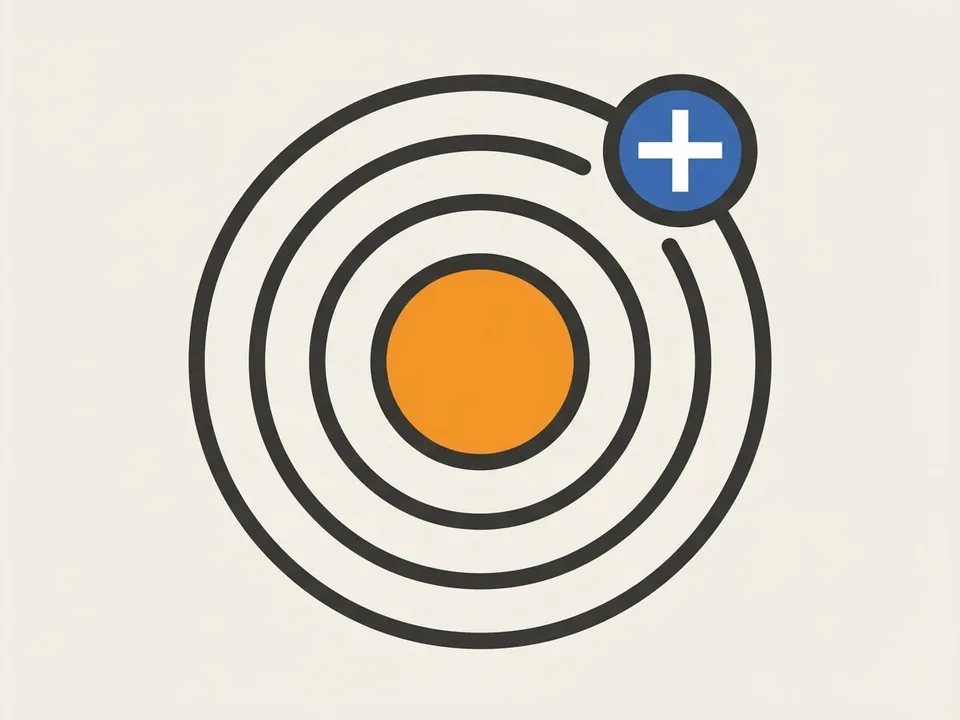
Ion là nguyên tử hoặc nhóm nguyên tử mang điện tích do đã mất bớt hoặc nhận thêm electron so với trạng thái trung hòa.An ion is an atom or group of atoms that carries an electric charge because it has lost or gained electrons relative to the neutral state.
Trực giác: Nguyên tử trung hòa giống người có tài khoản cân bằng thu chi; vay thêm hay cho bớt một electron là lập tức thành con nợ hoặc chủ nợ, tức là mang điện.Intuition: A neutral atom is like someone whose income and spending balance exactly. Borrow one electron or give one away, and you immediately become a debtor or a creditor — in other words, you carry a charge.
Công thức chínhKey formula
Định nghĩa đầy đủFull definition1 phút đọc1 min read
Ion là tiểu phân gồm một nguyên tử hoặc nhóm nguyên tử có điện tích vì số electron khác số proton. Nguyên tử mất electron tạo ion dương; nhận electron tạo ion âm, còn số proton không đổi. Ion đa nguyên tử gồm các nguyên tử liên kết cộng hóa trị và mang điện tích chung. Trong hợp chất ion, tỉ lệ các ion phải làm tổng điện tích bằng không.
An ion is a particle — a single atom or a covalently bonded group of atoms — that carries a charge because its number of electrons differs from its number of protons. An atom that loses electrons becomes a positive ion; one that gains electrons becomes a negative ion. In both cases the proton count stays the same. A polyatomic ion consists of atoms held together by covalent bonds that together carry an overall charge. In an ionic compound, the ions must combine in a ratio that makes the total charge zero.
- •, , ,
- •điện tích ghi phía trên bên phải ký hiệu
- •, , ,
- •charge is written as a superscript to the upper right of the symbol
Công thức chi tiếtFormula details2 công thức2 formulas
Dùng để tìm điện tích, số proton hoặc số electron khi biết hai đại lượng còn lại.Use this to find the charge, the number of protons, or the number of electrons when the other two quantities are known.
Trong đóWhere
Dùng để chọn tỉ lệ ion khi viết công thức hợp chất ion trung hòa.Use this to choose the ion ratio when writing the formula of a neutral ionic compound.
Trong đóWhere
Hay hiểu saiCommon misconceptions3 ý · 1 phút đọc3 points · 1 min read
Điện tích ion không biểu thị proton được thêm hoặc bớt.
Mất electron tạo ion dương; nhận electron tạo ion âm. Đổi số proton sẽ đổi nguyên tố, không chỉ tạo dạng tích điện của nguyên tố cũ.
Ion dương nhỏ hơn nguyên tử gốc, còn ion âm lớn hơn.
Mất electron làm bán kính giảm; nhận electron làm lực đẩy giữa các electron tăng. Với các tiểu phân đẳng electron, nhiều proton hơn tương ứng bán kính nhỏ hơn.
Không phải ion nào cũng đạt cấu hình khí hiếm.
Quy tắc bát tử phù hợp nhiều ion nhóm chính nhưng không áp dụng chung cho ion kim loại chuyển tiếp. Với chúng, viết cấu hình nguyên tử trung hòa rồi bỏ electron ở phân lớp s ngoài cùng trước.
The charge on an ion never tells you that protons were added or removed.
Losing electrons gives a positive ion and gaining electrons gives a negative ion. Changing the proton count changes the element itself, rather than producing a charged form of the original element.
Positive ions are smaller than their parent atoms, and negative ions are larger.
Removing electrons shrinks the radius, while adding electrons increases electron–electron repulsion. Among isoelectronic species, more protons means a smaller radius.
Not every ion ends up with a noble-gas configuration.
The octet rule works well for many main-group ions but does not extend to transition-metal ions in general. For those, write the neutral atom's configuration and remove electrons from the outermost s subshell first.
Mẹo phòng thiExam tips2 mẹo2 tips
Phương trình ion phải cân bằng cả nguyên tố lẫn tổng điện tích.
Sau khi cân bằng nguyên tử, hãy cộng điện tích mỗi vế; trong bán phản ứng, dùng electron để cân bằng điện tích.
Đếm electron trước khi nhận diện tiểu phân từ cấu hình.
Một cấu hình có thể thuộc về nguyên tử trung hòa hoặc nhiều ion. Hãy đọc rõ đề hỏi nguyên tử hay ion.
Ionic equations must balance both the elements and the total charge.
After balancing atoms, add up the charge on each side; in a half-reaction, use electrons to balance the charge.
Count the electrons before identifying a species from its configuration.
One configuration can belong to a neutral atom or to several different ions. Read carefully whether the question asks about an atom or an ion.
Khái niệm này sinh ra từ đâuWhere the concept comes from1 phút đọc1 min read
1834Michael FaradayWilliam Whewell
Vì sao mang đúng cái tên này? Cái tên nghe trừu tượng này thật ra mô tả một chuyển động rất cụ thể. "Ion" lấy từ phân từ hiện tại giống trung của động từ Hy Lạp ἰέναι (ienai), nghĩa là "đi" — nghĩa là ion được đặt tên theo việc nó đi qua dung dịch, chứ không theo việc nó mang điện tích. Cũng theo mạch đó, hai tên phái sinh dùng luôn hai trạng từ chỉ hướng trong tiếng Hy Lạp: κάτω (kato, "xuống") cho ion dương (cation) và ἄνω (ano, "lên") cho ion âm (anion). Chúng được gọi như vậy vì trong điện phân (electrolysis), mỗi loại di chuyển về phía điện cực mang điện tích trái dấu — cation về cathode, anion về anode. Do đó, khi làm bài về liên kết ion hay về điện phân, ta nên nhớ rằng hệ thuật ngữ này vốn sinh ra từ hướng đi trong bình điện phân chứ không phải từ dấu của điện tích; nhờ đó việc phân biệt cation với anion trở thành chuyện nhớ hướng, không phải chuyện học thuộc.
Thử nghiệm tương tácInteractive explorer
%22%20stroke-width%3D%221%22%2F%3E%3Ccircle%20cx%3D%22376.0%22%20cy%3D%22154.0%22%20r%3D%224.5%22%20fill%3D%22%2393c5fd%22%2F%3E%3Ccircle%20cx%3D%22264.0%22%20cy%3D%22154.0%22%20r%3D%224.5%22%20fill%3D%22%2393c5fd%22%2F%3E%3Ccircle%20cx%3D%22320%22%20cy%3D%22154%22%20r%3D%2286%22%20fill%3D%22none%22%20stroke%3D%22var(--border%2C%23e2e8f0)%22%20stroke-width%3D%221%22%2F%3E%3Ccircle%20cx%3D%22406.0%22%20cy%3D%22154.0%22%20r%3D%224.5%22%20fill%3D%22%2393c5fd%22%2F%3E%3Ccircle%20cx%3D%22380.8%22%20cy%3D%22214.8%22%20r%3D%224.5%22%20fill%3D%22%2393c5fd%22%2F%3E%3Ccircle%20cx%3D%22320.0%22%20cy%3D%22240.0%22%20r%3D%224.5%22%20fill%3D%22%2393c5fd%22%2F%3E%3Ccircle%20cx%3D%22259.2%22%20cy%3D%22214.8%22%20r%3D%224.5%22%20fill%3D%22%2393c5fd%22%2F%3E%3Ccircle%20cx%3D%22234.0%22%20cy%3D%22154.0%22%20r%3D%224.5%22%20fill%3D%22%2393c5fd%22%2F%3E%3Ccircle%20cx%3D%22259.2%22%20cy%3D%2293.2%22%20r%3D%224.5%22%20fill%3D%22%2393c5fd%22%2F%3E%3Ccircle%20cx%3D%22320.0%22%20cy%3D%2268.0%22%20r%3D%224.5%22%20fill%3D%22%2393c5fd%22%2F%3E%3Ccircle%20cx%3D%22380.8%22%20cy%3D%2293.2%22%20r%3D%224.5%22%20fill%3D%22%2393c5fd%22%2F%3E%3Ccircle%20cx%3D%22320%22%20cy%3D%22154%22%20r%3D%22116%22%20fill%3D%22none%22%20stroke%3D%22var(--border%2C%23e2e8f0)%22%20stroke-width%3D%221%22%2F%3E%3Ccircle%20cx%3D%22436.0%22%20cy%3D%22154.0%22%20r%3D%224.5%22%20fill%3D%22%2393c5fd%22%2F%3E%3Ccircle%20cx%3D%22320%22%20cy%3D%22154%22%20r%3D%2226%22%20fill%3D%22var(--accent-soft%2C%23ede9fe)%22%20stroke%3D%22var(--accent-strong%2C%237c3aed)%22%20stroke-width%3D%221.6%22%2F%3E%3Ctext%20x%3D%22320%22%20y%3D%2224%22%20text-anchor%3D%22middle%22%20font-size%3D%2217%22%20font-weight%3D%22700%22%20fill%3D%22var(--text%2C%230f172a)%22%3E%3Ctspan%20font-size%3D%2212%22%20fill%3D%22var(--text-muted%2C%2364748b)%22%3E23%3C%2Ftspan%3E%3Ctspan%3ENa%3C%2Ftspan%3E%3C%2Ftext%3E%3Ctext%20x%3D%22320%22%20y%3D%22310%22%20text-anchor%3D%22middle%22%20font-size%3D%2212%22%20fill%3D%22var(--text-muted%2C%2364748b)%22%3E11%20proton%20%C2%B7%2012%20neutron%20%C2%B7%2011%20electron%3C%2Ftext%3E%3C%2Fsvg%3E)
Bớt một electron của Na — nhãn thành Na⁺; bấm neutron xem điện tích có đổi
Kéo tham số, thấy khái niệm chuyển động — đăng nhập để mở.Drag the parameters and watch the concept move — sign in to open.
Bạn nắm chắc chưa?Check your understanding
Quiz câu thật từ ngân hàng đềReal exam questions from our question bank
Vài câu thật gắn đúng khái niệm này, chấm ngay kèm giải thích từng đáp án — hệ thống ghi nhớ bạn nắm tới đâu.A few real questions on exactly this concept, graded instantly with an explanation for every choice — the system remembers how well you know it.
Học tiếp từ đâyKeep learning
Hay nhầm vớiOften confused with
Cùng chủ đềSame topic
Nguồn tham khảoReferences
- [1]Chemistry The Central Science in SI Units 15th Expanded Global Edition. tr. 1–2, 4.
Biên soạn bởi DucklingStudy, bản quyền thuộc DucklingStudy.Written by DucklingStudy. © DucklingStudy. Xuất bảnPublished .