

AP Statistics
sai số biênmargin of error
margin of errorVietnamese: sai số biên
Còn gọi:Also called: maximum error of estimate
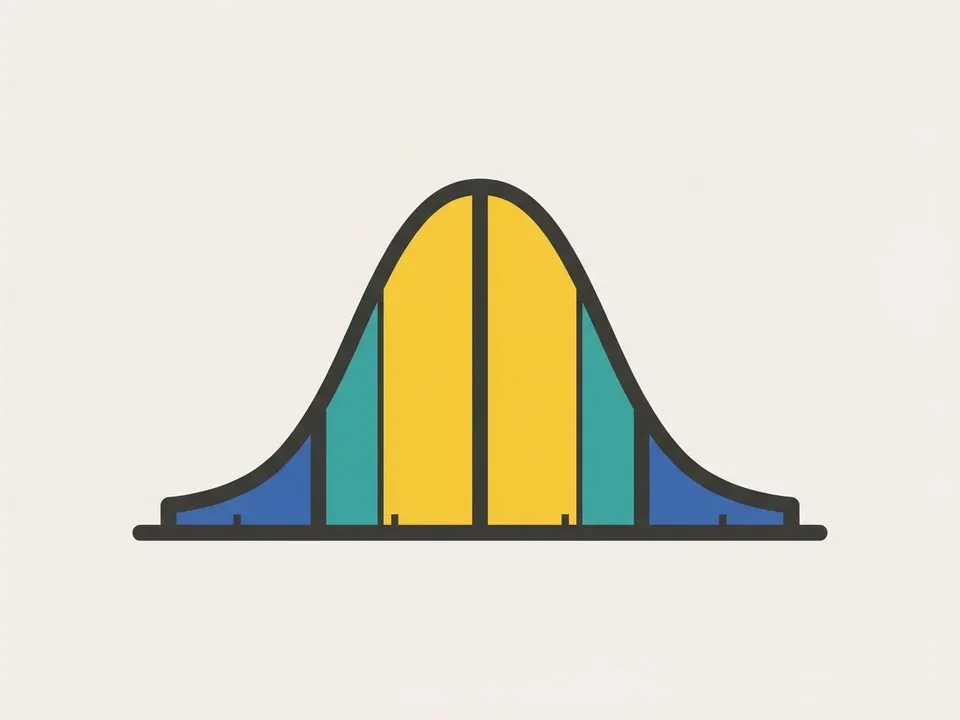
Sai số biên là nửa độ rộng của khoảng tin cậy, đo lượng sai lệch tối đa có thể chấp nhận giữa ước lượng điểm và tham số thực của tổng thể.The margin of error is half the width of a confidence interval; it measures how far the point estimate may plausibly differ from the true population parameter.
Trực giác: Sai số biên giống như bán kính vùng dao động dự kiến quanh con số ước lượng từ mẫu: nếu lặp lại khảo sát với nhiều mẫu khác nhau, các kết quả sẽ rơi rải rác trong vùng đó, phản ánh sự bất định do chỉ quan sát một phần tổng thể chứ không phải ngưỡng chấp nhận được.Intuition: Think of the margin of error as the radius of the region in which a sample-based estimate is expected to wander. If the survey were repeated with many different samples, the results would scatter within that region, which reflects the uncertainty of observing only part of the population rather than a threshold of acceptability.
Công thức chínhKey formula
Định nghĩa đầy đủFull definition1 phút đọc1 min read
Sai số biên là phần cộng trừ quanh ước lượng điểm trong khoảng tin cậy đối xứng. Với các khoảng nêu ở đây, nó bằng giá trị tới hạn nhân sai số chuẩn; khi biết độ lệch chuẩn tổng thể, sai số chuẩn của trung bình lấy độ lệch chuẩn ấy chia căn bậc hai cỡ mẫu.
Khi các yếu tố khác không đổi, sai số biên tăng theo mức tin cậy và tỉ lệ nghịch với căn bậc hai cỡ mẫu. Nó không phải độ lệch chuẩn; muốn giảm một nửa, phải tăng cỡ mẫu bốn lần.
The margin of error is the plus-or-minus amount placed around the point estimate in a symmetric confidence interval. For the intervals discussed here, it equals the critical value times the standard error; when the population standard deviation is known, the standard error of the mean is that standard deviation divided by the square root of the sample size.
All else equal, the margin of error grows as the confidence level increases and shrinks in proportion to the square root of the sample size. It is not a standard deviation, and cutting it in half requires four times the sample size.
Công thức chi tiếtFormula details3 công thức3 formulas
Dùng cho khoảng tin cậy của trung bình tổng thể khi đã biết độ lệch chuẩn tổng thể.Use this for a confidence interval for a population mean when the population standard deviation is known.
Trong đóWhere
Dùng cho khoảng tin cậy của trung bình tổng thể khi chưa biết độ lệch chuẩn tổng thể và phải dùng .Use this for a confidence interval for a population mean when the population standard deviation is unknown and must be used instead.
Trong đóWhere
Dùng khi lập khoảng tin cậy cho tỉ lệ tổng thể từ tỉ lệ mẫu .Use this when building a confidence interval for a population proportion from a sample proportion .
Trong đóWhere
Hay hiểu saiCommon misconceptions3 ý · 1 phút đọc3 points · 1 min read
Sai số biên không phải độ lệch chuẩn của mẫu.
Trong các khoảng tin cậy nêu ở đây, nó bằng giá trị tới hạn nhân sai số chuẩn; với trung bình mẫu, sai số chuẩn bằng độ lệch chuẩn chia căn bậc hai cỡ mẫu.
Khi ước lượng trung bình và chỉ biết độ lệch chuẩn mẫu, không mặc định dùng .
Với mức tin cậy , dùng với ; dùng sẽ cho khoảng hẹp hơn.
Muốn giảm sai số biên một nửa, tăng gấp đôi cỡ mẫu là chưa đủ.
Khi mức tin cậy và các yếu tố khác không đổi, sai số biên tỉ lệ nghịch với căn bậc hai cỡ mẫu, nên cỡ mẫu phải gấp bốn.
The margin of error is not the sample standard deviation.
In the confidence intervals discussed here, it equals the critical value times the standard error, and for a sample mean the standard error is the standard deviation divided by the square root of the sample size.
Do not default to when estimating a mean from the sample standard deviation alone.
At confidence, use with ; using produces an interval that is too narrow.
Doubling the sample size does not cut the margin of error in half.
With the confidence level and other factors fixed, the margin of error is inversely proportional to the square root of the sample size, so the sample size must be four times larger.
Mẹo phòng thiExam tips2 mẹo2 tips
Khi tìm cỡ mẫu cho tỉ lệ, luôn làm tròn lên.
Chọn số nguyên nhỏ nhất thỏa bất đẳng thức; nếu chưa có ước lượng tỉ lệ, dùng để đạt sai số biên lớn nhất.
Trong khoảng dùng phân phối chuẩn, hãy suy ra mức tin cậy từ .
Lấy sai số biên chia cho sai số chuẩn, rồi đối chiếu kết quả với mức tin cậy tương ứng.
When solving for a sample size for a proportion, always round up.
Take the smallest integer satisfying the inequality, and if no estimate of the proportion is available, use , which gives the largest margin of error.
For a confidence interval based on the normal distribution, recover the confidence level from .
Divide the margin of error by the standard error, then match the resulting critical value to its confidence level.
Khái niệm này sinh ra từ đâuWhere the concept comes from1 phút đọc1 min read
khoảng 1855–1860Jerzy Neyman — được một số tài liệu ghi nhận công hình thức hoá ý tưởng
Vì sao mang đúng cái tên này? Trong tiếng Anh, "margin" nghĩa là lề, khoảng dư ra ở mép; "margin of error" vì vậy là phần dư dành sẵn cho sai sót. Tên gọi phản ánh đúng cách dùng: người ta không khẳng định con số ước lượng là chính xác tuyệt đối mà chừa ra một khoảng lề hai bên. Cách dịch tiếng Việt "sai số biên" giữ nguyên hình ảnh đó — biên là mép, là ranh giới của khoảng tin cậy (confidence interval).
Thử nghiệm tương tácInteractive explorer
%22%20stroke-width%3D%223%22%20stroke-linecap%3D%22round%22%2F%3E%3Ccircle%20cx%3D%22214.0%22%20cy%3D%2227.9%22%20r%3D%223%22%20fill%3D%22var(--accent-strong%2C%237c3aed)%22%2F%3E%3Cline%20x1%3D%22275.8%22%20x2%3D%22546.0%22%20y1%3D%2247.7%22%20y2%3D%2247.7%22%20stroke%3D%22var(--accent-strong%2C%237c3aed)%22%20stroke-width%3D%223%22%20stroke-linecap%3D%22round%22%2F%3E%3Ccircle%20cx%3D%22410.9%22%20cy%3D%2247.7%22%20r%3D%223%22%20fill%3D%22var(--accent-strong%2C%237c3aed)%22%2F%3E%3Cline%20x1%3D%22216.9%22%20x2%3D%22492.4%22%20y1%3D%2267.6%22%20y2%3D%2267.6%22%20stroke%3D%22var(--accent-strong%2C%237c3aed)%22%20stroke-width%3D%223%22%20stroke-linecap%3D%22round%22%2F%3E%3Ccircle%20cx%3D%22354.7%22%20cy%3D%2267.6%22%20r%3D%223%22%20fill%3D%22var(--accent-strong%2C%237c3aed)%22%2F%3E%3Cline%20x1%3D%22216.9%22%20x2%3D%22492.4%22%20y1%3D%2287.4%22%20y2%3D%2287.4%22%20stroke%3D%22var(--accent-strong%2C%237c3aed)%22%20stroke-width%3D%223%22%20stroke-linecap%3D%22round%22%2F%3E%3Ccircle%20cx%3D%22354.7%22%20cy%3D%2287.4%22%20r%3D%223%22%20fill%3D%22var(--accent-strong%2C%237c3aed)%22%2F%3E%3Cline%20x1%3D%22306.7%22%20x2%3D%22571.5%22%20y1%3D%22107.3%22%20y2%3D%22107.3%22%20stroke%3D%22var(--accent-strong%2C%237c3aed)%22%20stroke-width%3D%223%22%20stroke-linecap%3D%22round%22%2F%3E%3Ccircle%20cx%3D%22439.1%22%20cy%3D%22107.3%22%20r%3D%223%22%20fill%3D%22var(--accent-strong%2C%237c3aed)%22%2F%3E%3Cline%20x1%3D%22188.7%22%20x2%3D%22464.3%22%20y1%3D%22127.1%22%20y2%3D%22127.1%22%20stroke%3D%22var(--accent-strong%2C%237c3aed)%22%20stroke-width%3D%223%22%20stroke-linecap%3D%22round%22%2F%3E%3Ccircle%20cx%3D%22326.5%22%20cy%3D%22127.1%22%20r%3D%223%22%20fill%3D%22var(--accent-strong%2C%237c3aed)%22%2F%3E%3Cline%20x1%3D%22135.1%22%20x2%3D%22405.3%22%20y1%3D%22146.9%22%20y2%3D%22146.9%22%20stroke%3D%22var(--accent-strong%2C%237c3aed)%22%20stroke-width%3D%223%22%20stroke-linecap%3D%22round%22%2F%3E%3Ccircle%20cx%3D%22270.2%22%20cy%3D%22146.9%22%20r%3D%223%22%20fill%3D%22var(--accent-strong%2C%237c3aed)%22%2F%3E%3Cline%20x1%3D%22109.7%22%20x2%3D%22374.5%22%20y1%3D%22166.7%22%20y2%3D%22166.7%22%20stroke%3D%22var(--accent-strong%2C%237c3aed)%22%20stroke-width%3D%223%22%20stroke-linecap%3D%22round%22%2F%3E%3Ccircle%20cx%3D%22242.1%22%20cy%3D%22166.7%22%20r%3D%223%22%20fill%3D%22var(--accent-strong%2C%237c3aed)%22%2F%3E%3Cline%20x1%3D%22161.5%22%20x2%3D%22435.3%22%20y1%3D%22186.6%22%20y2%3D%22186.6%22%20stroke%3D%22var(--accent-strong%2C%237c3aed)%22%20stroke-width%3D%223%22%20stroke-linecap%3D%22round%22%2F%3E%3Ccircle%20cx%3D%22298.4%22%20cy%3D%22186.6%22%20r%3D%223%22%20fill%3D%22var(--accent-strong%2C%237c3aed)%22%2F%3E%3Cline%20x1%3D%22135.1%22%20x2%3D%22405.3%22%20y1%3D%22206.4%22%20y2%3D%22206.4%22%20stroke%3D%22var(--accent-strong%2C%237c3aed)%22%20stroke-width%3D%223%22%20stroke-linecap%3D%22round%22%2F%3E%3Ccircle%20cx%3D%22270.2%22%20cy%3D%22206.4%22%20r%3D%223%22%20fill%3D%22var(--accent-strong%2C%237c3aed)%22%2F%3E%3Cline%20x1%3D%22161.5%22%20x2%3D%22435.3%22%20y1%3D%22226.2%22%20y2%3D%22226.2%22%20stroke%3D%22var(--accent-strong%2C%237c3aed)%22%20stroke-width%3D%223%22%20stroke-linecap%3D%22round%22%2F%3E%3Ccircle%20cx%3D%22298.4%22%20cy%3D%22226.2%22%20r%3D%223%22%20fill%3D%22var(--accent-strong%2C%237c3aed)%22%2F%3E%3Cline%20x1%3D%22188.7%22%20x2%3D%22464.3%22%20y1%3D%22246.1%22%20y2%3D%22246.1%22%20stroke%3D%22var(--accent-strong%2C%237c3aed)%22%20stroke-width%3D%223%22%20stroke-linecap%3D%22round%22%2F%3E%3Ccircle%20cx%3D%22326.5%22%20cy%3D%22246.1%22%20r%3D%223%22%20fill%3D%22var(--accent-strong%2C%237c3aed)%22%2F%3E%3Cline%20x1%3D%22319.5%22%20x2%3D%22319.5%22%20y1%3D%2212%22%20y2%3D%22262%22%20stroke%3D%22var(--warning%2C%23d97706)%22%20stroke-width%3D%222%22%20stroke-dasharray%3D%226%204%22%2F%3E%3Cline%20x1%3D%2224%22%20x2%3D%22622%22%20y1%3D%22262%22%20y2%3D%22262%22%20stroke%3D%22var(--text-faint%2C%2394a3b8)%22%2F%3E%3Ctext%20x%3D%2216%22%20y%3D%22288%22%20font-size%3D%2212%22%20fill%3D%22var(--text-muted%2C%2364748b)%22%3E12%20m%E1%BA%ABu%20%C2%B7%20n%20%3D%2025%20%C2%B7%20m%E1%BB%A9c%20tin%20c%E1%BA%ADy%2095%25%3C%2Ftext%3E%3C%2Fsvg%3E)
Kéo cỡ mẫu và mức tin cậy — nhìn nửa bề rộng của thanh co giãn
Kéo tham số, thấy khái niệm chuyển động — đăng nhập để mở.Drag the parameters and watch the concept move — sign in to open.
Bạn nắm chắc chưa?Check your understanding
Quiz câu thật từ ngân hàng đềReal exam questions from our question bank
Vài câu thật gắn đúng khái niệm này, chấm ngay kèm giải thích từng đáp án — hệ thống ghi nhớ bạn nắm tới đâu.A few real questions on exactly this concept, graded instantly with an explanation for every choice — the system remembers how well you know it.
Học tiếp từ đâyKeep learning
Hay nhầm vớiOften confused with
Cùng chủ đềSame topic
Nguồn tham khảoReferences
- [1]Barron_AP_Stat_2026. tr. 37, 49, 63.
Biên soạn bởi DucklingStudy, bản quyền thuộc DucklingStudy.Written by DucklingStudy. © DucklingStudy. Xuất bảnPublished .