

AP Chemistry
kim loạimetal
metalVietnamese: kim loại
Còn gọi:Also called: nguyên tố kim loại · metallic elements · metals
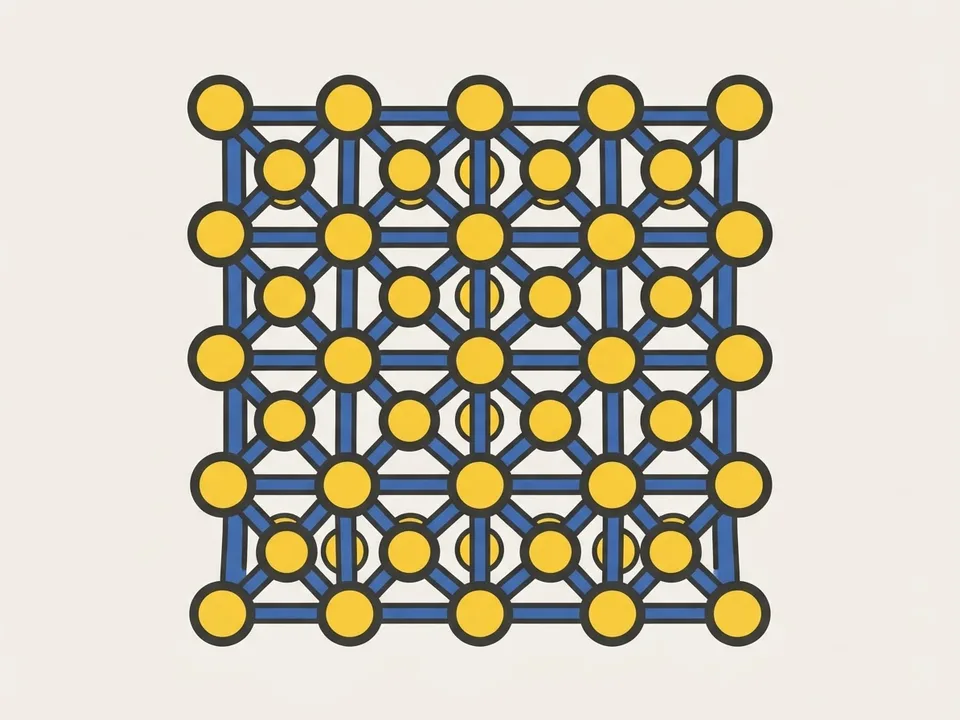
Kim loại là nguyên tố dễ nhường electron lớp ngoài cùng để tạo ion dương, có tính dẫn điện, dẫn nhiệt tốt, ánh kim và tính dẻo.A metal is an element whose atoms readily lose outer-shell electrons to form positive ions; metals conduct electricity and heat well and are lustrous and malleable.
Trực giác: Hãy tưởng tượng một nhóm người đứng giữa một bể nước — nước tràn ngập và chảy tự do quanh tất cả mọi người, gắn kết cả nhóm lại — các electron tự do trong kim loại cũng di chuyển tự do khắp mạng tinh thể như vậy.Intuition: Picture a crowd of people standing in a shallow pool — the water floods in and flows freely around everyone, holding the whole group together. The free electrons in a metal move just as freely throughout the crystal lattice.
Định nghĩa đầy đủFull definition1 phút đọc1 min read
Kim loại là nguyên tố có nguyên tử thường dễ nhường electron hóa trị để tạo cation. Khi tham gia phản ứng oxi hoá–khử bằng cách nhường electron, kim loại là chất khử. Trong tinh thể, electron hóa trị phi định xứ di chuyển qua mạng cation, tạo liên kết kim loại và khả năng dẫn điện, dẫn nhiệt.
Liên kết không định hướng cho phép các lớp nguyên tử trượt mà mạng không vỡ, tạo tính dẻo; bề mặt phản xạ ánh sáng tạo ánh kim.
A metal is an element whose atoms typically lose their valence electrons easily to form cations. When a metal takes part in a redox reaction by giving up electrons, it acts as the reducing agent. In a metallic crystal, the delocalized valence electrons move freely through a lattice of cations, producing metallic bonding along with high electrical and thermal conductivity.
Because metallic bonding is nondirectional, layers of atoms can slide past one another without breaking the lattice, which makes metals malleable and ductile; the surface reflects light, giving metals their characteristic luster.
Hay hiểu saiCommon misconceptions3 ý · 1 phút đọc3 points · 1 min read
Kim loại không dẫn điện nhờ ion chuyển động.
Trong mô hình biển electron, electron hóa trị linh động và phi định xứ truyền điện tích qua mạng cation khi có hiệu điện thế.
Tính dát mỏng không chứng tỏ liên kết kim loại yếu.
Liên kết không định hướng vẫn duy trì lực hút khi các lớp cation trượt; tinh thể ion có thể vỡ vì ion cùng dấu bị đưa cạnh nhau.
Không phải kim loại nào cũng phản ứng với .
Với bạc hoặc đồng, thế khử chuẩn của cặp ion/kim loại dương hơn , nên phản ứng với không tự diễn biến ở điều kiện chuẩn.
Metals do not conduct electricity by means of moving ions.
In the sea-of-electrons model, mobile delocalized valence electrons carry charge through the lattice of fixed cations when a potential difference is applied.
Malleability is not evidence that metallic bonding is weak.
Nondirectional bonding keeps the attraction intact as layers of cations slide, whereas an ionic crystal can shatter because ions of like charge are forced side by side.
Not every metal reacts with .
For silver or copper, the standard reduction potential of the ion/metal couple is more positive than , so reaction with is not spontaneous under standard conditions.
Mẹo phòng thiExam tips2 mẹo2 tips
Đừng chỉ kết luận liên kết kim loại mạnh hơn.
Khi so sánh điểm nóng chảy bằng mô hình tĩnh điện, hãy xét điện tích cation, số electron phi định xứ và bán kính để giải thích lực hút với biển electron.
Luôn ghi tỉ lệ mol electron khi tìm khối lượng mol kim loại.
Dù dữ kiện là khí hydrogen hay điện lượng , phải xét số electron kim loại nhường trước khi suy ra số mol kim loại và dùng .
Don't stop at saying the metallic bonding is simply stronger.
When you compare melting points with an electrostatic model, discuss cation charge, the number of delocalized electrons, and ionic radius to explain the attraction to the electron sea.
Always write the electron mole ratio when finding a metal's molar mass.
Whether the data give hydrogen gas or a charge , work out how many electrons the metal loses before deducing the moles of metal and applying .
Bạn nắm chắc chưa?Check your understanding
Quiz câu thật từ ngân hàng đềReal exam questions from our question bank
Vài câu thật gắn đúng khái niệm này, chấm ngay kèm giải thích từng đáp án — hệ thống ghi nhớ bạn nắm tới đâu.A few real questions on exactly this concept, graded instantly with an explanation for every choice — the system remembers how well you know it.
Học tiếp từ đâyKeep learning
Hay nhầm vớiOften confused with
Cùng chủ đềSame topic
Nguồn tham khảoReferences
- [1]Chemistry The Central Science in SI Units 15th Expanded Global Edition. tr. 2, 11, 14.
Biên soạn bởi DucklingStudy, bản quyền thuộc DucklingStudy.Written by DucklingStudy. © DucklingStudy. Xuất bảnPublished .