

AP Statistics
độ lệch chuẩnstandard deviation
standard deviationVietnamese: độ lệch chuẩn
Còn gọi:Also called: SD · độ lệch tiêu chuẩn
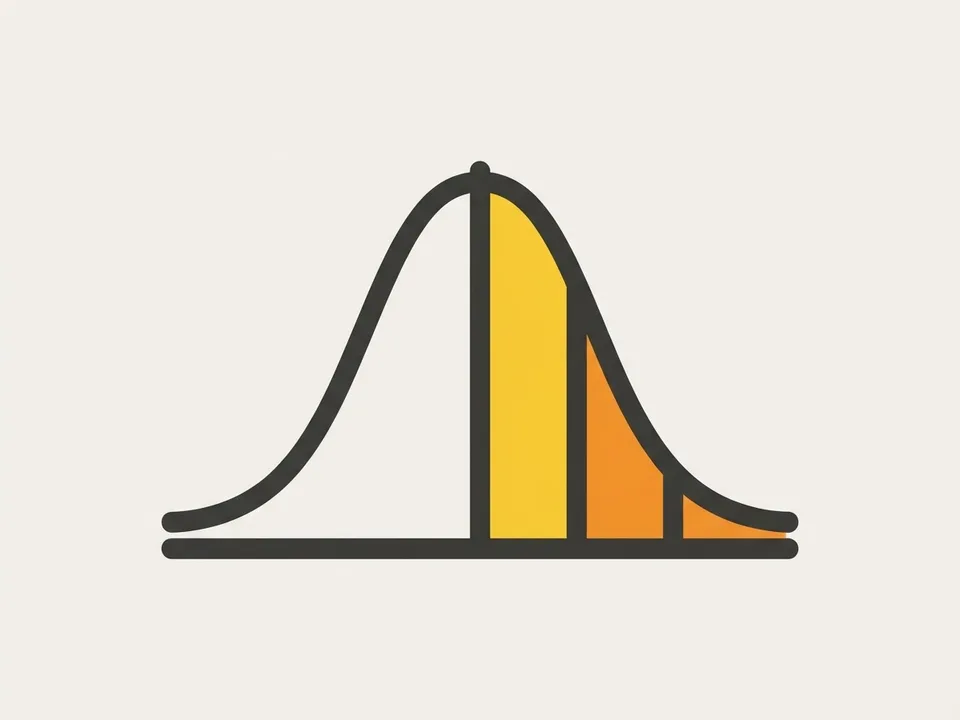
Độ lệch chuẩn là đại lượng đo mức phân tán của dữ liệu quanh trung bình, bằng căn bậc hai của phương sai và cùng đơn vị với dữ liệu gốc.Standard deviation measures how spread out data are around the mean; it is the square root of the variance and carries the same units as the original data.
Trực giác: Trung bình mà nói, mỗi quan sát cách giá trị trung bình khoảng chừng ấy.Intuition: On average, each observation sits about this far from the mean.
Công thức chínhKey formula
Định nghĩa đầy đủFull definition1 phút đọc1 min read
Độ lệch chuẩn cho biết các quan sát điển hình cách giá trị trung bình bao xa — bằng căn bậc hai của phương sai. Dữ liệu càng túm tụm quanh trung bình thì độ lệch chuẩn càng nhỏ; dữ liệu càng trải rộng thì càng lớn.
Với mẫu, ký hiệu là và chia cho (bậc tự do); với tổng thể, ký hiệu là và chia cho . Đề AP hầu như luôn làm việc với .
Độ lệch chuẩn không kháng outlier: một giá trị bất thường kéo trung bình lệch đi và thổi phồng — khi phân phối lệch mạnh hoặc có outlier, mô tả độ phân tán bằng IQR sẽ trung thực hơn.
Standard deviation tells you how far a typical observation falls from the mean — it is the square root of the variance. The more tightly the data cluster around the mean, the smaller the standard deviation; the more spread out they are, the larger it gets.
For a sample, it is written and you divide by (the degrees of freedom); for a population, it is written and you divide by . AP questions work with almost every time.
Standard deviation is not resistant to outliers: a single unusual value pulls the mean toward it and inflates . When a distribution is strongly skewed or contains outliers, the IQR gives a more honest picture of spread.
- • (mẫu)
- • (tổng thể)
- • (sample)
- • (population)
Công thức chi tiếtFormula details2 công thức2 formulas
Dùng khi cần đo mức phân tán của một mẫu số liệu quanh giá trị trung bình; đây là công thức xuất hiện trên formula sheet AP Statistics.Use this when you need the spread of a data sample about its mean; this is the version that appears on the AP Statistics formula sheet.
Trong đóWhere
Dùng khi cộng hoặc trừ hai biến ngẫu nhiên độc lập; áp dụng cho cả tổng lẫn hiệu vì phương sai luôn cộng.Use this when you add or subtract two independent random variables; it holds for both the sum and the difference because variances always add.
Trong đóWhere
Hay hiểu saiCommon misconceptions3 ý · 1 phút đọc3 points · 1 min read
Đừng nhầm phương sai với độ lệch chuẩn: phương sai có đơn vị bình phương, đem dùng cho z-score là sai.
Cộng hằng số vào mọi quan sát không làm đổi; chỉ nhân hệ số mới nhân .
Với phân phối lệch mạnh, hãy dùng median và IQR thay cho và .
Variance and standard deviation are not interchangeable.
Variance is in squared units, so plugging it into a z-score calculation gives a wrong answer.
Adding a constant to every observation leaves unchanged.
Only multiplying the data by a factor scales by that same factor, because shifting does not change distances from the mean.
For a strongly skewed distribution, report the median and IQR instead of and .
Both the mean and the standard deviation get dragged by the long tail.
Mẹo phòng thiExam tips2 mẹo2 tips
FRQ mô tả phân phối: nêu đủ shape – center – spread (và outlier) trong ngữ cảnh của đề.
Máy Casio/TI cho cả (Sx) lẫn (σx) — đề cho MẪU thì lấy Sx.
When an FRQ asks you to describe a distribution, give shape, center, and spread (plus any outliers).
Say all of it in the context of the problem to earn full credit.
A Casio or TI calculator reports both (Sx) and (σx).
If the problem gives you a SAMPLE, read off Sx.
Thử nghiệm tương tácInteractive explorer
%22%20stroke%3D%22var(--accent-strong%2C%237c3aed)%22%20stroke-width%3D%221.6%22%2F%3E%3Ccircle%20cx%3D%22228.8%22%20cy%3D%22184.0%22%20r%3D%229%22%20fill%3D%22var(--accent-soft%2C%23ede9fe)%22%20stroke%3D%22var(--accent-strong%2C%237c3aed)%22%20stroke-width%3D%221.6%22%2F%3E%3Ccircle%20cx%3D%22228.8%22%20cy%3D%22165.0%22%20r%3D%229%22%20fill%3D%22var(--accent-soft%2C%23ede9fe)%22%20stroke%3D%22var(--accent-strong%2C%237c3aed)%22%20stroke-width%3D%221.6%22%2F%3E%3Ccircle%20cx%3D%22247.0%22%20cy%3D%22184.0%22%20r%3D%229%22%20fill%3D%22var(--accent-soft%2C%23ede9fe)%22%20stroke%3D%22var(--accent-strong%2C%237c3aed)%22%20stroke-width%3D%221.6%22%2F%3E%3Ccircle%20cx%3D%22247.0%22%20cy%3D%22165.0%22%20r%3D%229%22%20fill%3D%22var(--accent-soft%2C%23ede9fe)%22%20stroke%3D%22var(--accent-strong%2C%237c3aed)%22%20stroke-width%3D%221.6%22%2F%3E%3Ccircle%20cx%3D%22247.0%22%20cy%3D%22146.0%22%20r%3D%229%22%20fill%3D%22var(--accent-soft%2C%23ede9fe)%22%20stroke%3D%22var(--accent-strong%2C%237c3aed)%22%20stroke-width%3D%221.6%22%2F%3E%3Ccircle%20cx%3D%22247.0%22%20cy%3D%22127.0%22%20r%3D%229%22%20fill%3D%22var(--accent-soft%2C%23ede9fe)%22%20stroke%3D%22var(--accent-strong%2C%237c3aed)%22%20stroke-width%3D%221.6%22%2F%3E%3Ccircle%20cx%3D%22265.3%22%20cy%3D%22184.0%22%20r%3D%229%22%20fill%3D%22var(--accent-soft%2C%23ede9fe)%22%20stroke%3D%22var(--accent-strong%2C%237c3aed)%22%20stroke-width%3D%221.6%22%2F%3E%3Ccircle%20cx%3D%22265.3%22%20cy%3D%22165.0%22%20r%3D%229%22%20fill%3D%22var(--accent-soft%2C%23ede9fe)%22%20stroke%3D%22var(--accent-strong%2C%237c3aed)%22%20stroke-width%3D%221.6%22%2F%3E%3Ccircle%20cx%3D%22283.5%22%20cy%3D%22184.0%22%20r%3D%229%22%20fill%3D%22var(--accent-soft%2C%23ede9fe)%22%20stroke%3D%22var(--accent-strong%2C%237c3aed)%22%20stroke-width%3D%221.6%22%2F%3E%3Cline%20x1%3D%2228%22%20x2%3D%22612%22%20y1%3D%22194%22%20y2%3D%22194%22%20stroke%3D%22var(--text-faint%2C%2394a3b8)%22%20stroke-width%3D%221.2%22%2F%3E%3Ctext%20x%3D%22320%22%20y%3D%22238%22%20text-anchor%3D%22middle%22%20font-size%3D%2212%22%20fill%3D%22var(--text-muted%2C%2364748b)%22%3ETh%E1%BB%9Di%20gian%20ch%E1%BB%9D%20(ph%C3%BAt)%3C%2Ftext%3E%3C%2Fsvg%3E)
Kéo các chấm dồn lại rồi banh ra — nhìn ô độ lệch chuẩn đổi số
Kéo tham số, thấy khái niệm chuyển động — đăng nhập để mở.Drag the parameters and watch the concept move — sign in to open.
Bạn nắm chắc chưa?Check your understanding
Quiz câu thật từ ngân hàng đềReal exam questions from our question bank
Vài câu thật gắn đúng khái niệm này, chấm ngay kèm giải thích từng đáp án — hệ thống ghi nhớ bạn nắm tới đâu.A few real questions on exactly this concept, graded instantly with an explanation for every choice — the system remembers how well you know it.
Học tiếp từ đâyKeep learning
Hay nhầm vớiOften confused with
Cùng chủ đềSame topic
Nguồn tham khảoReferences
- [1]Barron_AP_Stat_2026. tr. 114, 116.
Biên soạn bởi DucklingStudy, bản quyền thuộc DucklingStudy.Written by DucklingStudy. © DucklingStudy. Xuất bảnPublished .